



Between October 14th and 17th, representatives from the Shift2DC consortium partners – the Power Electronics Group of Tallinn University of Technology (TalTech) and Tecnalia — participated in IEEE IECON 2025, the flagship annual conference of the IEEE Industrial Electronics Society, held in Madrid, Spain.
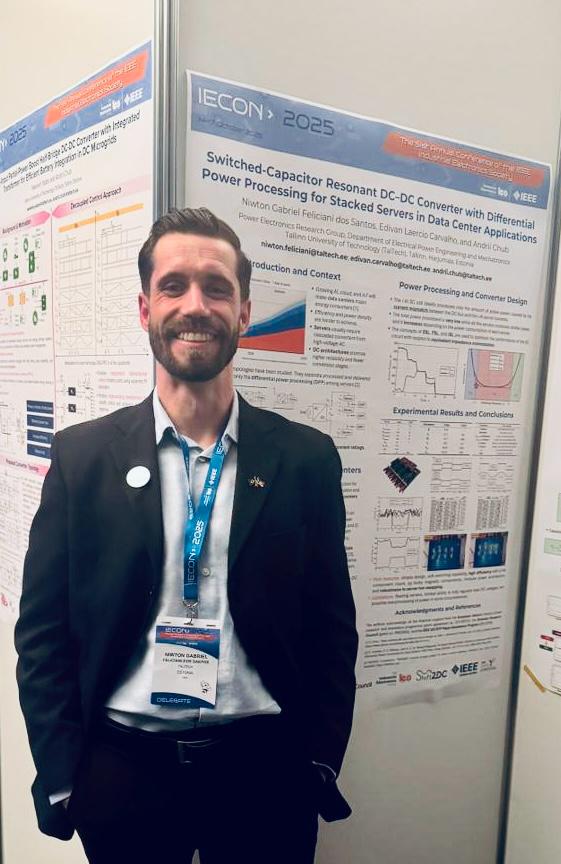
At the event, TalTech researcher Niwton Feliciani presented the university’s research under the Shift2DC Project, focused on DC systems and power electronics, with the paper titled “Switched-Capacitor Resonant DC–DC Converter with Differential Power Processing for Stacked Servers in Data Center Applications”. The paper received the IEEE IES-SYPA Award and was also featured in a poster session during the conference.
“I am very proud to be one of the winners of the prestigious IES SYPA Award. This recognition underscores the importance of the topics addressed by the Shift2DC Horizon Europe project in promoting smarter and more efficient direct current (DC) systems and helping to reshape the way we use electricity. This achievement is not individual, so I would like to express my gratitude to my co-authors Edivan Laercio Carvalho and Andrii Chub, the Shift2DC project, and the IES committee members for their invaluable volunteer work and continuous support.”
The research introduces an innovative approach for efficient DC power distribution and voltage regulation in data centers, proposing a switched-capacitor resonant DC-DC converter with differential power processing (DPP) that enables servers to be electrically connected in series, improving overall system efficiency.
Also presenting at IECON 2025 was Asier Aristondo from Tecnalia, who introduced the research paper “Extending the Generalized Bode Criterion to Black-Box Power Systems: A Practical Approach for Stability Evaluation”, co-authored by Salvador Ceballos, Alain Sanchez-Ruiz, and Robert Grinó.
The paper presents a new graphical approach that simplifies the application of the Generalized Bode Criterion by enabling the direct extraction of all necessary parameters from the Bode plot of system impedances. The method further facilitates the use of the Generalized Bode Criterion in the analysis of DC grids represented by black-box models, without requiring an explicit transfer function. Therefore, offering a robust and versatile solution for stability evaluation in complex power systems. In the paper, the method is validated via simulations analyzing the stability of a DC-DC converter connected to a DC grid through and inductive filter, for which stable and unstable cases are studied.
More about the event here.
Comments are closed.